1
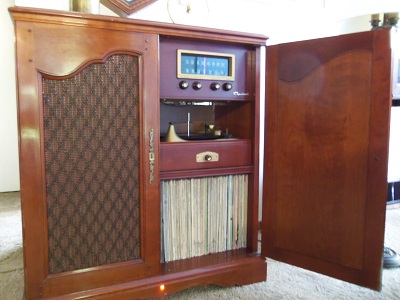
This is the Capehart llRP-125F (c. 1954) and was an early introduction into HI-Fi quality sound. It was manufactured by the Capehart-Farnsworth Company of Ft. Wayne, In. Capehart, like its contemporary, Magnavox (both based in Ft. Wayne) were well known for quality sound reproduction emulating from solid-wood cabinets built of only the finest quality woods. Cabinets were made by the well-known furniture maker, Drexel. In traditional early-American styling, this is a Drexel cherry-wood cabinet. The storage compartment has room for about 150 Long Play albums. This unit can be considered a gift that keeps on giving. A few years ago, I did a complete restoration of the chassis and turntable. I was surprised and excited when the owner called and offered it to me. He was doing some remodeling and downsizing his collections. As a young man, he remembered listening to it at the home of its original owner. The original owner gave it to him many years ago. One day I will present it to someone as well.
2
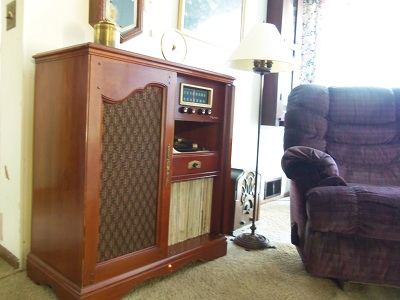
Sound reproduction emulates from two speakers especially designed by Capehart engineers. The speakers are enclosed within a specially designed cabinet box which is the left-hand half of the console. Base notes are heard through an 8 in. woofer. The size is small compared to the standard of the day. However, remember, it was specially designed by Capehart engineers for the size speaker box it is enclosed in. The horn tweeter emits highs in near-stratospheric proportions.
3
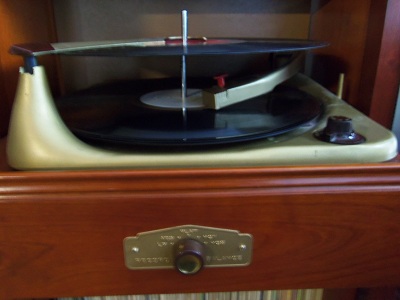
The three-speed high-fidelity record changer, manufactured by Voice of Music (VM) has the General Electric Variable Reluctance cartridge installed in its tonearm. The GE cartridge is a low-impedance magnetic cartridge which was used to reproduce recorded sound in earliest high-fidelity units and was used for a number of years. The cartridge requires a separate single-tube (6SC7) pre-amp. The output of the cartridge feeds into a Record Balance Control (front of changer drawer), a 5-position resistance/capaciatence control when properly adjusted, provides that the recording be reproduced with the same balance as was used by the recording company. This concept is the true meaning of the term High Fidelity.
4
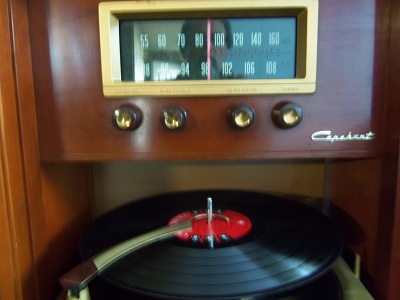
The control panel, handsome, is simple in design. Controls, L-R are Off/On and Volume, Bass/Treble, AM/FM/Phono/SS (Special Service position for accessories such as a TV receiver or tape recorder) and Tuning control.
Prev
Next